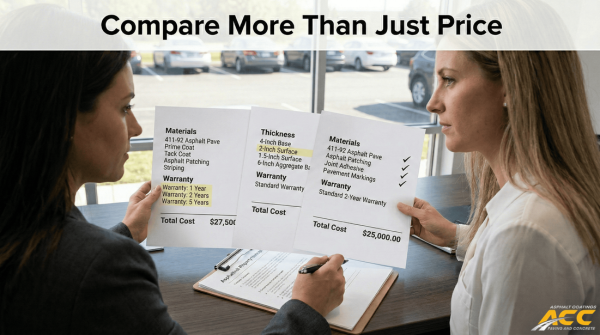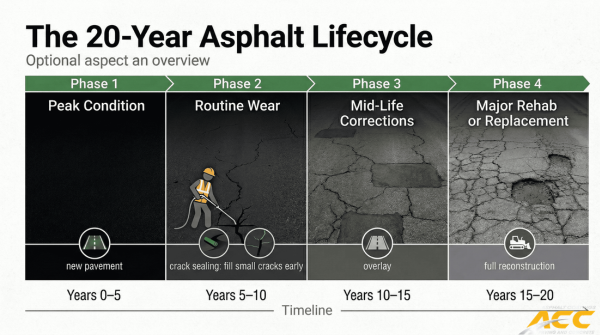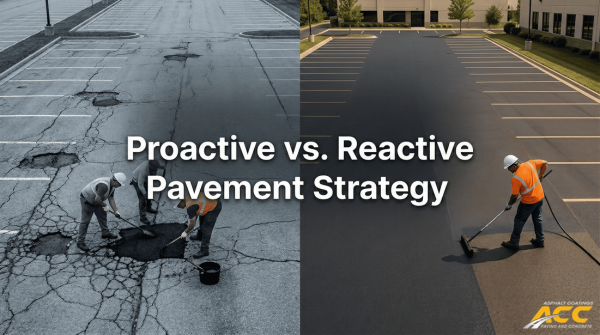
Commercial property managers evaluate asphalt paving bids by analyzing scope clarity, contractor qualifications, pricing structure, timelines, and long-term value to balance quality, cost, and risk. We understand that selecting the right contractor requires careful analysis of multiple factors while balancing quality, cost, and long-term value. With change orders averaging 10% of total contract value and poor information early in the process causing 80% of these modifications, the initial bid evaluation becomes critical to project success.
According to the National Asphalt Pavement Association (2025), proper bid evaluation can reduce emergency repairs by up to 70% and extend pavement life from 10-12 years with neglect to 25-30 years with proper maintenance. In 2024, CrewSafety Work Zone Training documented that a single fatigued construction worker can cost $3,500 per year in lost productivity through slowdowns, mistakes, and overtime. This underscores why thorough contractor evaluation matters.
“The most critical factor in successful asphalt paving projects is the initial contractor selection process,” states the Building Owners and Managers Association. “Detailed scope definition and proper bid leveling enable property managers to identify the best value rather than simply the lowest price.”
Key Evaluation Takeaways:
- Detailed scope of work must include bill of quantities, projected schedule, and specific task descriptions for accurate bid comparison
- Contractors need minimum insurance coverage of $1M General Liability, Workers’ Compensation, and Commercial Auto
- Commercial parking lots cost $4-7 per square foot with site preparation adding 20-50% to base costs
- Proper bid leveling software creates side-by-side comparisons revealing scope gaps and pricing anomalies
- Warranty terms should range from 1-5 years with clear exclusions and limitations defined
- Safety certifications including OSHA compliance and Experience Modification Rate (EMR) indicate contractor reliability
High-Level Evaluation Process:
We begin by establishing clear project requirements and creating a detailed scope of work that enables accurate bid comparison. Next, we verify contractor credentials including licenses, insurance, and safety records. Then we analyze pricing structures using bid leveling techniques to identify hidden costs and scope gaps. Following this, we assess contractor experience through past project reviews and client references. Finally, we evaluate long-term value through warranty terms, maintenance programs, and ROI projections.
Practical Evaluation Tips:
- Request itemized pricing breakdowns to identify potential change order risks early
- Verify all subcontractors carry adequate insurance through Certificate of Insurance requirements
This comprehensive approach ensures we select contractors who deliver quality results while minimizing risks and maximizing property value. As we explore each evaluation criterion in detail, you’ll discover how systematic assessment protects your investment and ensures successful project outcomes.
What Criteria Do Commercial Property Managers Use When Reviewing Asphalt Paving Bids?
Commercial property managers review asphalt paving bids using six key criteria: scope of work clarity, material quality standards, contractor qualifications, pricing structure, timeline feasibility, and warranty coverage. These evaluation factors determine project success and long-term pavement performance. The following sections examine how managers assess each criterion to select qualified contractors and avoid costly mistakes.
How Do Managers Assess the Scope of Work in Paving Proposals?
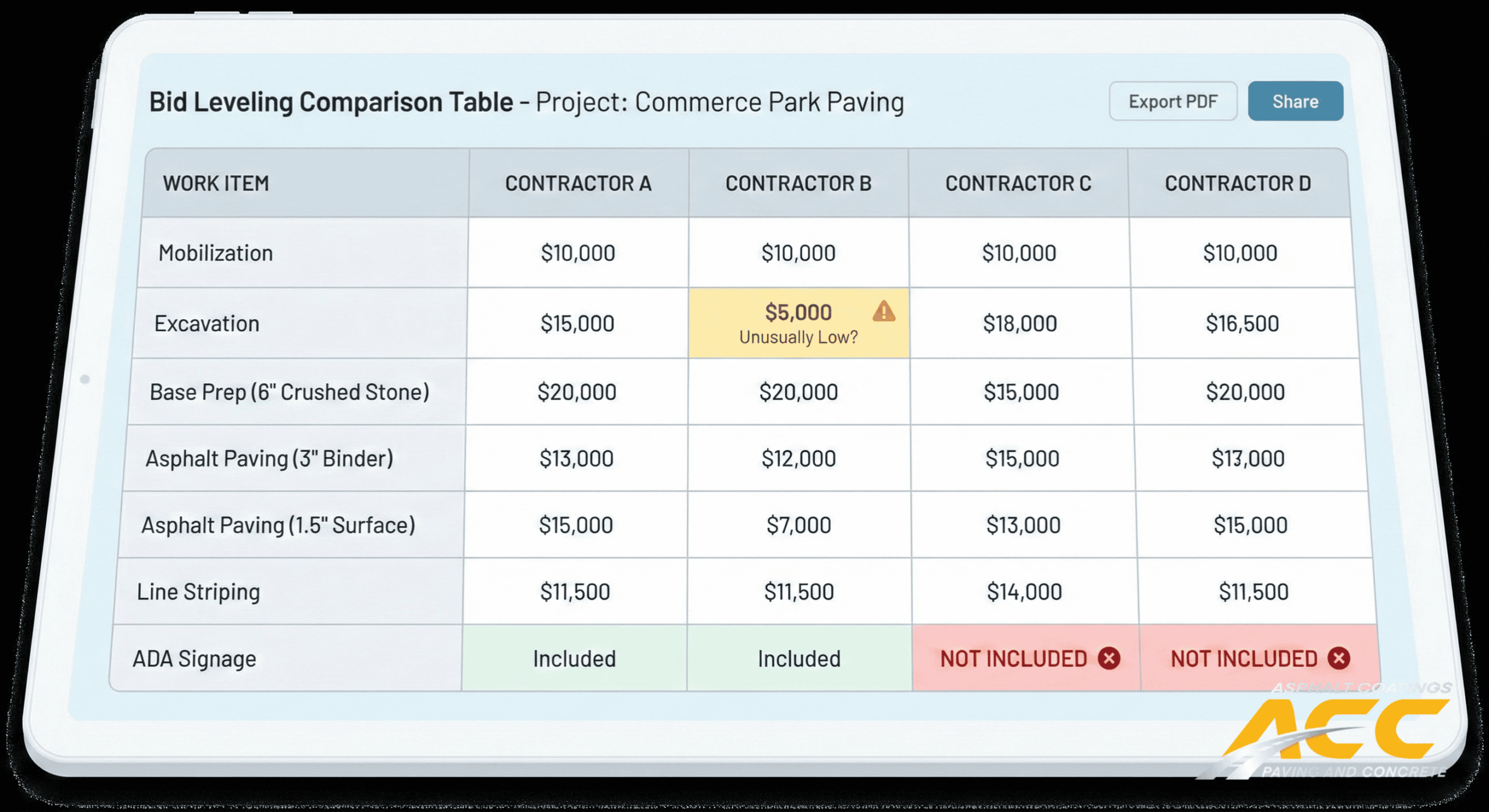
Managers assess the scope of work by examining bill of quantities, projected schedules, safety requirements, labor hours, and task descriptions. Detailed scope documentation enables accurate bid comparison. Bid leveling software organizes information into comparison tables with columns for each bidder and rows for each work item.
According to a 2023 construction industry report, poor scope definition causes 80% of change orders. Change orders average 10% of total contract value, with some projects reaching 25% in additional costs. Granular scope details help identify gaps, missing items, and anomalous pricing before contract signing.
The most effective proposals break down specific activities, material quantities, and resource allocations. This level of detail prevents misunderstandings and reduces project delays.
What Role Does Material Quality Play in the Evaluation Process?
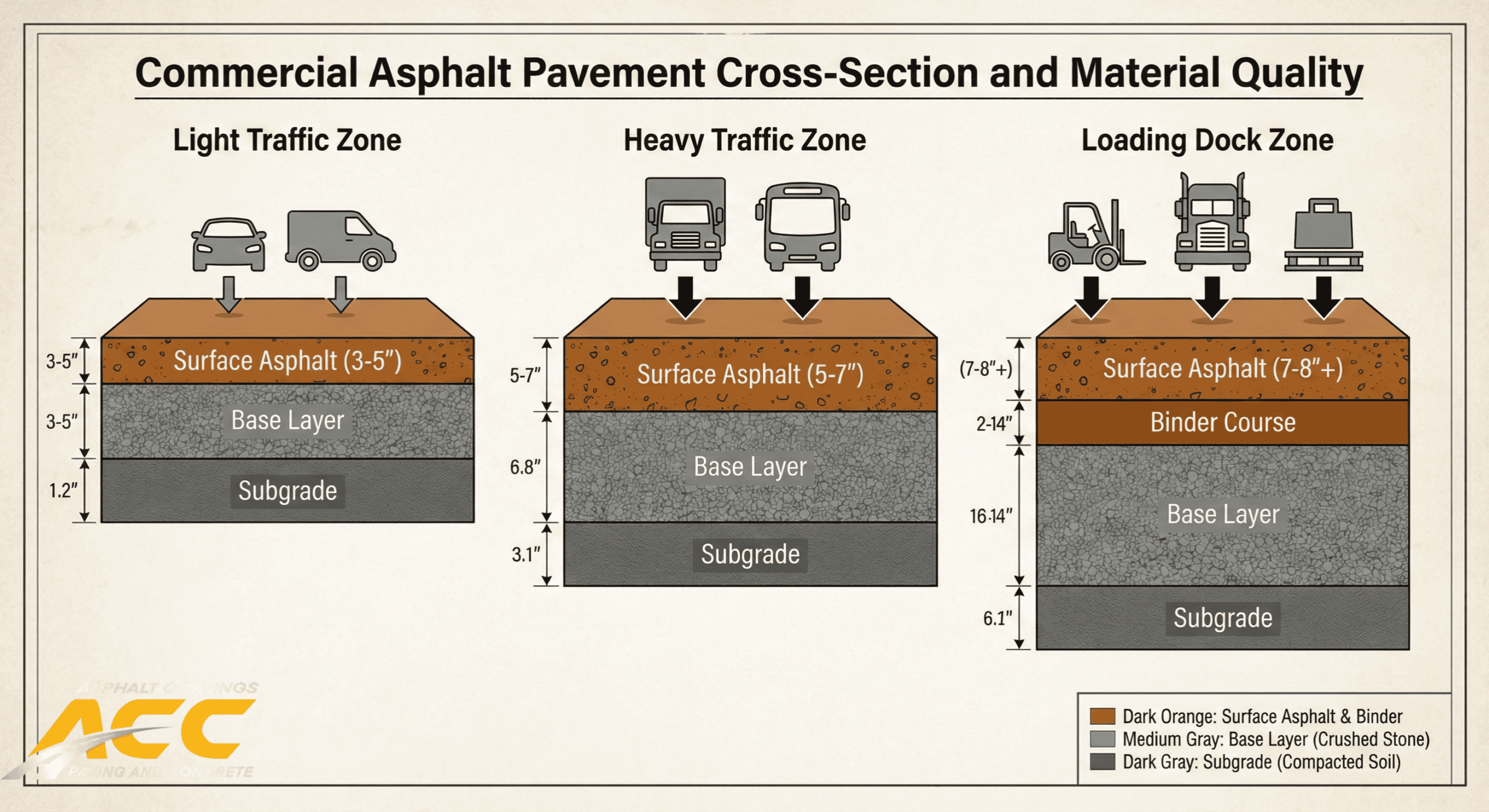
Material quality determines pavement longevity and performance under commercial traffic loads. Hot-mix asphalt costs $100-200 per ton, with material-only costs ranging $5-7 per square foot. Each additional inch of thickness adds $0.75-1.25 per square foot.
Commercial pavement requires specific thickness standards:
- Light commercial areas: 3-4 inches
- Heavy traffic zones: 4-6 inches
- Loading docks: 6-8 inches
Poor-quality materials cause premature failure. Inadequate base preparation creates structural weakness. Thin asphalt layers shorten lifespan significantly. Reputable contractors provide warranties covering both materials and workmanship, demonstrating confidence in their quality standards.
Why Is the Contractor’s Experience and Reputation Important?
The contractor’s experience and reputation are important because they indicate the ability to execute projects correctly, comply with regulations, and consistently deliver quality results. Required credentials include state contractor licenses, OSHA safety certification, and EPA environmental certification. DOT prequalification demonstrates financial stability, technical capabilities, and safety record compliance.
The Diamond Commendation Program recognizes asphalt plant best practices for quality and safety. Experience Modification Rate (EMR) reflects workplace safety performance. Safe workplaces maintain lower EMR scores, earning workers’ compensation premium discounts.
Contractors with established reputations complete projects on schedule, handle unexpected challenges professionally, and maintain consistent quality standards across multiple projects.
How Do Managers Compare Bid Pricing and Cost Structure?
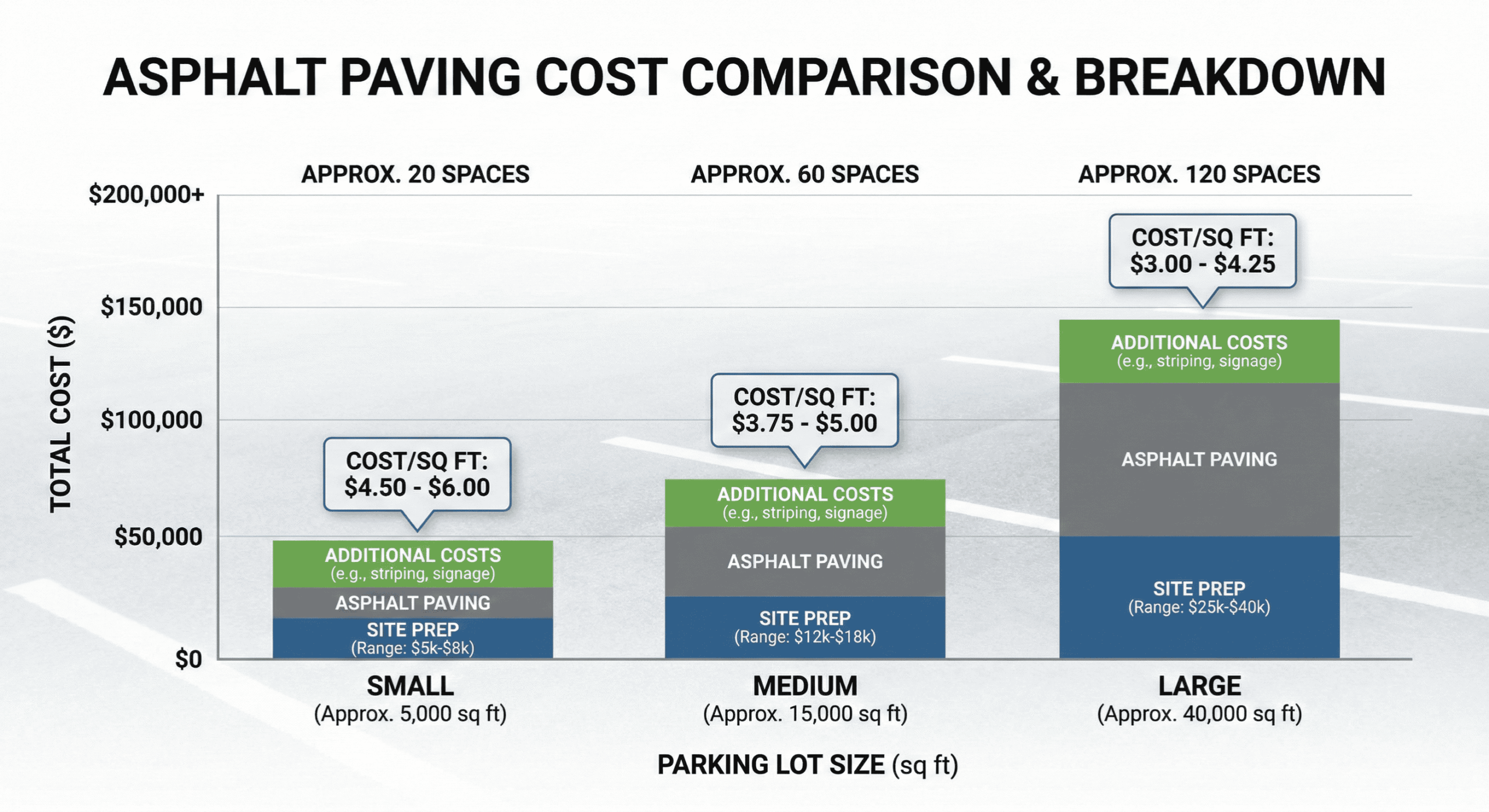
Managers compare bid pricing by analyzing per-square-foot costs, site preparation expenses, and total project values. Commercial parking lots cost $4-7 per square foot. Projects under 500 square feet cost $5-7 per square foot, while projects over 5,000 square feet cost $3-4 per square foot.
| Parking Lot Size | Square Footage | Spaces | Cost Range |
| Small | 5,000 | 20 | $20,000-$35,000 |
| Medium | 15,000 | 60 | $60,000-$105,000 |
| Large | 30,000 | 120 | $120,000-$210,000 |
Site preparation adds 20-50% to base costs. Variables include excavation depth, soil stabilization, drainage installation, and existing pavement removal. Asphalt costs 30-40% less than concrete for initial installation. Oil prices, aggregate availability, and seasonal demand affect final pricing.
What Should Property Managers Look for in Project Timeline Estimates?
Property managers should look for project timeline estimates that clearly detail each construction phase, duration, and traffic restoration schedule. Standard commercial lot installation takes 1-3 days. A 20,000-square-foot parking lot requires 2-4 days for completion.
Project phase durations include:
- Planning: 2-4 weeks
- Site preparation: 1-2 weeks
- Paving: 2-7 days depending on size
- Light traffic use: 24-48 hours post-paving
- Full curing: 1 week minimum
Small site preparation takes 2-3 days. Larger projects require over one week. Most commercial projects allow traffic within 24-48 hours, though curing continues for several months. Realistic timelines account for weather delays and material availability.
How Do Warranty and Maintenance Options Factor into the Decision?
Warranty and maintenance options factor into the decision by protecting property managers from early pavement failure and reducing long-term ownership costs. Asphalt paving warranties range 1-5 years with clear exclusion definitions. Short-term performance warranties last 5-10 years depending on pavement type.
Warranty coverage by project type:
- Full depth replacement: 3-year limited warranty
- Milling and overlay: 1-year limited warranty
- Sealcoating: 6-12 month warranty
A 2022 pavement management study found properly maintained lots reduce emergency repairs by 70%. Pavement lasts 25-30 years with maintenance versus 10-12 years without. Maintenance plans include annual inspections, sealcoating every 3-4 years, crack sealing, pothole repair, and ADA-compliant line striping. These warranty and maintenance factors directly impact total ownership costs and property value preservation.
What Documentation and Certifications Should Be Included in a Qualified Asphalt Paving Bid?
A qualified asphalt paving bid requires comprehensive documentation including insurance proof, licensing credentials, safety records, and industry certifications. Property managers evaluate these documents to verify contractor legitimacy, financial stability, and regulatory compliance before awarding contracts. The following subsections detail essential documentation requirements for contractor evaluation.
Why Are Proof of Insurance and Licensing Required?
Proof of insurance and licensing are required because they protect property owners from liability and confirm that contractors meet minimum professional and legal standards. General Liability Insurance costs average $77 per month with typical limits of $1 million per occurrence and $2 million aggregate. Workers’ Compensation costs average $260 per month and most states mandate coverage for contractors with employees.
Commercial Auto Insurance averages $173 per month and should include $1 million limits rather than state minimums. Small paving contractors’ comprehensive insurance packages start at $5,000 annually. California exemplifies strict requirements with its C-12 license from the Contractors State License Board mandating minimum $1 million general liability insurance and $25,000 license bond.
These insurance requirements protect property managers from accidents, property damage, and worker injuries during paving projects.
How Do Safety Records and Compliance Affect Bid Selection?
Safety records and compliance affect bid selection by demonstrating a contractor’s commitment to safe operations, regulatory adherence, and risk reduction. Contractors must comply with OSHA safety standards covering proper material handling, PPE use, and safe equipment operation. Safety performance evaluation examines accident history, regulatory compliance on past projects, and ability to maintain safe work practices.
According to industry data, a single fatigued construction worker costs $3,500 annually in lost productivity through slowdowns, mistakes, longer cleanup, and overtime. CrewSafety Work Zone Training provides online training helping asphalt employees recognize unsafe situations with full documentation. Every paving project requires a comprehensive safety plan including incident response procedures for accidents or emergencies.
Strong safety records indicate lower project risk and potential insurance savings for property managers.
What Certifications or Accreditations Indicate Trustworthy Asphalt Contractors?
Certifications and accreditations that indicate trustworthy asphalt contractors include NICET certifications, NAICS codes, and recognized environmental credentials. NICET Certifications are most required by local and state jurisdictions and federal agencies for asphalt testing. NAICS Codes classify contractor expertise for government agencies and are mandatory for federal projects.
| Certification / Credential | Role or Purpose | What It Indicates |
| NICET Certification | Required by | Local/state/federal agencies |
| NAICS Codes | Purpose | Classify contractor expertise |
| Emerald Eco-Label | Function | Report environmental impacts |
| NAPA Webinars | Benefit | Professional development hours |
| Business Owner’s Policy | Average cost | $172/month |
Emerald Eco-Label helps companies report potential environmental impacts of asphalt mixtures for green construction rating systems. NAPA Webinars provide education on engineering, health and safety, and environmental regulations with professional development hours earned. Business Owner’s Policies cost average $172 per month, bundling general liability and commercial property insurance.
These certifications demonstrate technical competence, regulatory compliance, and commitment to industry best practices that property managers value when selecting contractors.
How Can Commercial Property Managers Ensure Accurate Comparison Among Multiple Bids?
Commercial property managers can ensure accurate comparison among multiple bids by using systematic evaluation processes focused on scope clarity, complete documentation, and site-specific assessments. According to a 2023 construction industry analysis, 80% of change orders stem from poor information early in the bidding process, making detailed comparison methods essential for project success.
What Are Common Pitfalls When Comparing Paving Bid Proposals?
Common pitfalls when comparing paving bid proposals include inadequate scope definition, missing compliance requirements, and overlooked contractor prequalification standards. Without granular scope of work specifications, bid leveling becomes extremely difficult with no specific items to compare across proposals. A 2024 industry report reveals that change orders impact 35% of all projects, with average cost increases ranging from 3.2% for smallest buildings to 5.04% for $1-5M buildings.
Compliance violations present serious risks, such as diesel fuel usage as an asphalt release agent, which violates all DOT specifications. Contractors caught using diesel can face job removal, suspension, or substantial fines. Traditional prequalification limiting bidding to pre-approved contractors may increase initial bid prices but delivers significant savings through reduced lost productivity and decreased liability exposure.
How Should Clarifications and Follow-Up Questions Be Handled With Contractors?
Clarifications and follow-up questions should be handled through written documentation that clearly captures cost breakdowns, timelines, and scope specifications. Property managers must obtain written estimates from multiple contractors ensuring each proposal includes comprehensive breakdown of costs, timeline, and scope of work. Essential inquiries include:
- Quality of asphalt mix and processes used
- Warranties for materials and workmanship
- Proof of licensing, bonding, and insurance
- Subcontractor insurance verification through Certificates of Insurance
Reputable contractors stand behind their work with clear warranty terms and comply with all local regulations. Written clarifications prevent misunderstandings and create an audit trail for bid comparison purposes.
Why Is an On-Site Inspection or Assessment Important Before Final Review?
An on-site inspection before final review is important because it reveals site-specific conditions that directly affect scope accuracy, costs, and timelines. Surface damage inspection identifies cracks, potholes, raveling with loose aggregates, and depressions that collect water. Drainage evaluation ensures water flows away from pavement surfaces, as poor drainage accelerates deterioration rates significantly.
| Assessment Area | Key Indicators | Cost Impact |
| High-traffic zones | Fading striping, rutting, structural failures | Increased thickness requirements |
| Edging conditions | Crumbling edges, vegetation overgrowth | Additional repair scope |
| Site accessibility | Equipment access, space constraints | 10-15% cost variation |
| Drainage systems | Water pooling, flow patterns | 20-50% additional preparation costs |
Site accessibility particularly impacts pricing—easy access reduces costs by 10-15% while tight spaces require smaller equipment and increase labor hours. These findings directly influence bid accuracy and help managers identify proposals that properly account for site-specific challenges.
What Are Typical Red Flags or Warning Signs in Asphalt Paving Bids?
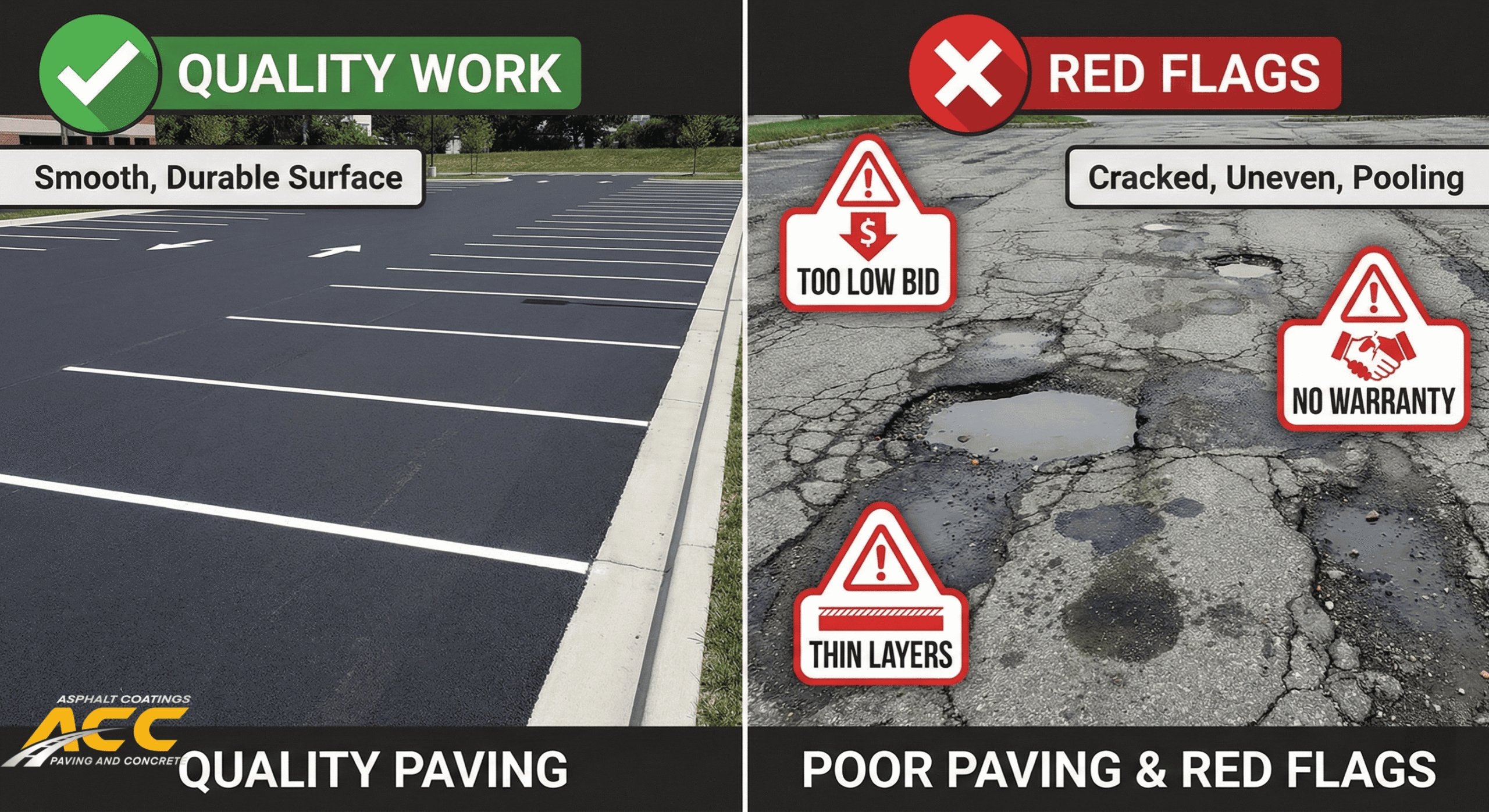
Typical red flags in asphalt paving bids include unrealistically low pricing, vague proposals, and hidden fees that inflate costs through change orders. Commercial property managers must identify these warning signs to avoid contractors who deliver substandard work or inflate costs through change orders. Understanding these risks protects investments and ensures successful project outcomes.
How Do Unrealistically Low Bids Signal Potential Risks?
Unrealistically low bids signal potential risks by indicating that essential materials, labor, or site preparation may be excluded from the proposal. Asphalt material alone costs $5 to $7 per square foot, with installation adding $3 to $10 per square foot under favorable conditions. Commercial parking lots should cost $4 to $7 per square foot for standard 3 to 4 inch thickness with heavy-duty base preparation.
Bids significantly below $3 per square foot for commercial work likely exclude necessary site preparation, proper thickness, or quality materials. Poor-quality materials and inadequate base preparation lead to premature failure requiring complete repaving within 5 years instead of the expected 25-year lifespan. Diesel contamination from improper release agents causes cracking, rutting, and early pavement failure requiring mill and repave operations costing double the original project price.
Why Are Vague or Incomplete Proposals Problematic?
Vague or incomplete proposals are problematic because they prevent accurate bid comparison and conceal financial, technical, and compliance risks. Proposals must include specific breakdown of excavation depth requirements, soil stabilization needs, drainage system installation, and existing pavement removal specifications. Missing insurance documentation represents a major red flag since contractors need General Liability at $1 million per occurrence, Workers’ Compensation, Commercial Auto, and Tools & Equipment coverage.
Lack of safety plan details indicates potential OSHA compliance issues and higher accident risk. Proposals without specific material specifications such as thickness measurements, mix type designations, and aggregate source locations prevent accurate comparison between competing bids. Absence of warranty terms and exclusions leaves property managers exposed to early pavement failure costs averaging $15,000 to $20,000 per 10,000 square feet.
How Do Change Order Terms and Hidden Fees Affect Project Outcomes?
Change order terms and hidden fees affect project outcomes by increasing total costs well beyond the original bid price. According to a 2024 industry study, change orders account for 8 to 10 percent of a project’s total cost on average. Some projects experience 25 percent in change order costs, transforming a $100,000 project into a $125,000 expense.
The national average shows 3 to 5 percent of change orders result from architect and engineer errors and omissions, with many contracts including a 2 percent standard allowance. Contract modifications that increase value from 5 to 10 percent are expected in construction projects. Hidden costs include equipment downtime at $40,000 per year per machine, material waste from carryback causing 10 percent loss per load, and fines for illegal practices such as using diesel fuel as a release agent.
Property managers reviewing asphalt paving bids must scrutinize pricing structures, verify complete documentation, and understand change order implications to select qualified contractors who deliver lasting value.
How Can Commercial Property Managers Optimize the Bidding and Selection Process for Asphalt Projects?
Commercial property managers can optimize the bidding and selection process for asphalt projects by using systematic bid leveling, contractor prequalification, and standardized evaluation tools. A 2019 Construction Industry Institute study found that projects using structured bid evaluation processes experienced 23% fewer change orders and 18% lower total costs.
What Best Practices Help Streamline the Bid Review Process?
Best practices that help streamline the bid review process include bid leveling software, contractor prequalification systems, and standardized KPI tracking. Bid leveling organizes construction bids into tables with columns for each bidder and rows for each work item. Software automatically imports bid information for side-by-side comparison with pricing tied to scope items.
Contractor prequalification evaluates capabilities, financial stability, and past performance before allowing bids. Property managers create comprehensive questionnaires with standardized checklists ensuring consistent evaluation criteria. According to a 2021 Associated General Contractors report, prequalification reduces project delays by 35% and cost overruns by 28%.
Key performance indicators track operational efficiency:
- Tons per hour (crew and truck production)
- Feet per minute (paving speed)
- Cycle time (truck turnaround)
- Trucking cost per ton (TCpT)
These metrics enable objective contractor comparison and performance benchmarking against industry standards.
How Do Managers Establish Clear Project Goals and Expectations Upfront?
Managers establish clear project goals and expectations upfront by creating detailed scope documentation, repair prioritization frameworks, and measurable performance standards. The scope must include bill of quantities, projected schedule, safety personnel requirements, insurance specifications, labor hours, and task descriptions.
Repair prioritization follows a three-tier system:
- Safety concerns (potholes, large cracks)
- Preventive maintenance (seal small cracks)
- Aesthetic issues (faded striping)
Insurance requirements protect property managers from liability. Minimum coverage includes General Liability ($1M occurrence/$2M aggregate), Workers’ Compensation, and Commercial Auto ($1M limits). A 2022 Insurance Information Institute study showed adequate coverage reduced claim disputes by 67%.
Warranty terms vary by project type. Full depth replacement requires 3-year coverage, overlays need 1-year minimum, and standard paving warrants 1-5 years. Performance standards reference NAPA best practices documentation and industry KPIs for measurable accountability.
What Tools or Templates Can Assist in Comparing and Scoring Bids?
Tools and templates that assist in comparing and scoring bids include bid leveling software, standardized evaluation matrices, and ROI analysis frameworks. Bid leveling software automatically imports information creating comparative tables with pricing matched to scope items.
| Evaluation Category | Assessment Criteria | Weight |
| Business Information | Licenses, insurance, financials | 25% |
| Safety Performance | OSHA records, EMR rating | 20% |
| Financial Stability | Credit score, cash flow, legal issues | 30% |
| Technical Capability | Equipment, crew size, past projects | 25% |
Prequalification scoring examines credit scores, cash flow projections, and outstanding debts. ROI templates calculate operational savings from reduced maintenance costs, fewer liability claims, and asset appreciation. A 2020 facility management survey found structured bid scoring reduced selection time by 40% while improving contractor quality.
Performance bonds provide risk mitigation with Class A-1 rates for asphalt projects offering competitive surety bond costs. These tools create objective, repeatable processes that eliminate bias and ensure consistent contractor selection across multiple projects.
The optimization of bidding and selection processes transforms asphalt project procurement from subjective decision-making into data-driven contractor selection. Next, partnering with specialized asphalt companies provides additional expertise and support throughout the evaluation process.
How Can Partnering With a Specialized Asphalt Paving Company Benefit Commercial Property Managers?
Partnering with a specialized asphalt paving company benefits commercial property managers by providing expert bid evaluation, ROI analysis, and long-term maintenance planning. A specialized contractor brings industry knowledge that transforms complex paving decisions into data-driven investments. Property managers gain access to professional assessment tools, warranty-backed services, and long-term asset protection strategies.
How Can Asphalt Coatings Company Support Commercial Property Managers in Evaluating Paving Bids?
Asphalt Coatings Company supports commercial property managers in evaluating paving bids by analyzing proposals against industry benchmarks and ROI projections. Service life of asphalt pavement ranges from 15 to 30 years depending on initial quality and maintenance program implementation. A 2023 industry analysis shows average parking lot investment of $50,000 yields $10,000 per year in reduced liability claims, $8,000 per year in maintenance reduction, and 15% revenue increase through improved property appeal.
The typical payback period for commercial asphalt investment is 2-3 years with proper maintenance planning. Sealcoating commercial parking lots costs $0.20 to $0.50 per square foot and extends pavement life when performed every 3-4 years. Performance bonds guarantee contractor obligations with Class A-1 rates for asphalt being most competitive in construction industry.
Specialized contractors evaluate bids using proven metrics such as tons per hour, cycle time, and trucking cost per ton. There are multiple evaluation criteria including contractor prequalification scores, insurance verification, and warranty term analysis. Professional bid leveling ensures accurate scope comparison while identifying potential gaps that lead to costly change orders.
What Are the Key Takeaways on How Commercial Property Managers Evaluate Asphalt Paving Bids?
The key takeaways on how commercial property managers evaluate asphalt paving bids include detailed scope requirements, thorough contractor vetting, and lifecycle cost analysis. Bid evaluation requires detailed scope of work, proper bid leveling, and contractor prequalification to ensure accurate comparison between proposals. Insurance minimums include $1M General Liability, Workers’ Compensation, and Commercial Auto, with comprehensive packages starting at $5,000 annually.
Commercial parking lot costs range $4-7 per square foot with site preparation adding 20-50% to base costs. According to a 2024 construction industry report, change orders average 10% of contract value, with 80% caused by poor information early in process. Properly maintained asphalt lasts 25-30 years versus 10-12 years with neglect, reducing emergency repairs by up to 70%.
Property managers maximize value through systematic bid evaluation using:
- Detailed scope breakdown with bill of quantities
- Contractor prequalification scoring systems
- Insurance and certification verification
- Warranty term comparison (1-5 years standard)
- Maintenance program cost projections
Professional asphalt contractors provide transparent pricing, proven track records, and comprehensive maintenance programs that protect commercial property investments long-term.
How Commercial Property Managers Evaluate Asphalt Paving Bids
Commercial property managers evaluate asphalt paving bids by analyzing scope clarity, contractor qualifications, pricing structure, timelines, and long-term value to balance quality, cost, and risk. We understand that selecting the right contractor requires careful analysis of multiple factors while balancing quality, cost, and long-term value. With change orders averaging 10% of total contract value and poor information early in the process causing 80% of these modifications, the initial bid evaluation becomes critical to project success.
According to the National Asphalt Pavement Association (2025), proper bid evaluation can reduce emergency repairs by up to 70% and extend pavement life from 10-12 years with neglect to 25-30 years with proper maintenance. In 2024, CrewSafety Work Zone Training documented that a single fatigued construction worker can cost $3,500 per year in lost productivity through slowdowns, mistakes, and overtime. This underscores why thorough contractor evaluation matters.
“The most critical factor in successful asphalt paving projects is the initial contractor selection process,” states the Building Owners and Managers Association. “Detailed scope definition and proper bid leveling enable property managers to identify the best value rather than simply the lowest price.”
Key Evaluation Takeaways:
- Detailed scope of work must include bill of quantities, projected schedule, and specific task descriptions for accurate bid comparison
- Contractors need minimum insurance coverage of $1M General Liability, Workers’ Compensation, and Commercial Auto
- Commercial parking lots cost $4-7 per square foot with site preparation adding 20-50% to base costs
- Proper bid leveling software creates side-by-side comparisons revealing scope gaps and pricing anomalies
- Warranty terms should range from 1-5 years with clear exclusions and limitations defined
- Safety certifications including OSHA compliance and Experience Modification Rate (EMR) indicate contractor reliability
High-Level Evaluation Process:
We begin by establishing clear project requirements and creating a detailed scope of work that enables accurate bid comparison. Next, we verify contractor credentials including licenses, insurance, and safety records. Then we analyze pricing structures using bid leveling techniques to identify hidden costs and scope gaps. Following this, we assess contractor experience through past project reviews and client references. Finally, we evaluate long-term value through warranty terms, maintenance programs, and ROI projections.
Practical Evaluation Tips:
- Request itemized pricing breakdowns to identify potential change order risks early
- Verify all subcontractors carry adequate insurance through Certificate of Insurance requirements
This comprehensive approach ensures we select contractors who deliver quality results while minimizing risks and maximizing property value. As we explore each evaluation criterion in detail, you’ll discover how systematic assessment protects your investment and ensures successful project outcomes.
What Criteria Do Commercial Property Managers Use When Reviewing Asphalt Paving Bids?
Commercial property managers review asphalt paving bids using six key criteria: scope of work clarity, material quality standards, contractor qualifications, pricing structure, timeline feasibility, and warranty coverage. These evaluation factors determine project success and long-term pavement performance. The following sections examine how managers assess each criterion to select qualified contractors and avoid costly mistakes.
How Do Managers Assess the Scope of Work in Paving Proposals?
Managers assess the scope of work by examining bill of quantities, projected schedules, safety requirements, labor hours, and task descriptions. Detailed scope documentation enables accurate bid comparison. Bid leveling software organizes information into comparison tables with columns for each bidder and rows for each work item.
According to a 2023 construction industry report, poor scope definition causes 80% of change orders. Change orders average 10% of total contract value, with some projects reaching 25% in additional costs. Granular scope details help identify gaps, missing items, and anomalous pricing before contract signing.
The most effective proposals break down specific activities, material quantities, and resource allocations. This level of detail prevents misunderstandings and reduces project delays.
What Role Does Material Quality Play in the Evaluation Process?
Material quality determines pavement longevity and performance under commercial traffic loads. Hot-mix asphalt costs $100-200 per ton, with material-only costs ranging $5-7 per square foot. Each additional inch of thickness adds $0.75-1.25 per square foot.
Commercial pavement requires specific thickness standards:
- Light commercial areas: 3-4 inches
- Heavy traffic zones: 4-6 inches
- Loading docks: 6-8 inches
Poor-quality materials cause premature failure. Inadequate base preparation creates structural weakness. Thin asphalt layers shorten lifespan significantly. Reputable contractors provide warranties covering both materials and workmanship, demonstrating confidence in their quality standards.
Why Is the Contractor’s Experience and Reputation Important?
The contractor’s experience and reputation are important because they indicate the ability to execute projects correctly, comply with regulations, and consistently deliver quality results. Required credentials include state contractor licenses, OSHA safety certification, and EPA environmental certification. DOT prequalification demonstrates financial stability, technical capabilities, and safety record compliance.
The Diamond Commendation Program recognizes asphalt plant best practices for quality and safety. Experience Modification Rate (EMR) reflects workplace safety performance. Safe workplaces maintain lower EMR scores, earning workers’ compensation premium discounts.
Contractors with established reputations complete projects on schedule, handle unexpected challenges professionally, and maintain consistent quality standards across multiple projects.
How Do Managers Compare Bid Pricing and Cost Structure?
Managers compare bid pricing by analyzing per-square-foot costs, site preparation expenses, and total project values. Commercial parking lots cost $4-7 per square foot. Projects under 500 square feet cost $5-7 per square foot, while projects over 5,000 square feet cost $3-4 per square foot.
| Parking Lot Size | Square Footage | Spaces | Cost Range |
| Small | 5,000 | 20 | $20,000-$35,000 |
| Medium | 15,000 | 60 | $60,000-$105,000 |
| Large | 30,000 | 120 | $120,000-$210,000 |
Site preparation adds 20-50% to base costs. Variables include excavation depth, soil stabilization, drainage installation, and existing pavement removal. Asphalt costs 30-40% less than concrete for initial installation. Oil prices, aggregate availability, and seasonal demand affect final pricing.
What Should Property Managers Look for in Project Timeline Estimates?
Property managers should look for project timeline estimates that clearly detail each construction phase, duration, and traffic restoration schedule. Standard commercial lot installation takes 1-3 days. A 20,000-square-foot parking lot requires 2-4 days for completion.
Project phase durations include:
- Planning: 2-4 weeks
- Site preparation: 1-2 weeks
- Paving: 2-7 days depending on size
- Light traffic use: 24-48 hours post-paving
- Full curing: 1 week minimum
Small site preparation takes 2-3 days. Larger projects require over one week. Most commercial projects allow traffic within 24-48 hours, though curing continues for several months. Realistic timelines account for weather delays and material availability.
How Do Warranty and Maintenance Options Factor into the Decision?
Warranty and maintenance options factor into the decision by protecting property managers from early pavement failure and reducing long-term ownership costs. Asphalt paving warranties range 1-5 years with clear exclusion definitions. Short-term performance warranties last 5-10 years depending on pavement type.
Warranty coverage by project type:
- Full depth replacement: 3-year limited warranty
- Milling and overlay: 1-year limited warranty
- Sealcoating: 6-12 month warranty
A 2022 pavement management study found properly maintained lots reduce emergency repairs by 70%. Pavement lasts 25-30 years with maintenance versus 10-12 years without. Maintenance plans include annual inspections, sealcoating every 3-4 years, crack sealing, pothole repair, and ADA-compliant line striping. These warranty and maintenance factors directly impact total ownership costs and property value preservation.
What Documentation and Certifications Should Be Included in a Qualified Asphalt Paving Bid?
A qualified asphalt paving bid requires comprehensive documentation including insurance proof, licensing credentials, safety records, and industry certifications. Property managers evaluate these documents to verify contractor legitimacy, financial stability, and regulatory compliance before awarding contracts. The following subsections detail essential documentation requirements for contractor evaluation.
Why Are Proof of Insurance and Licensing Required?
Proof of insurance and licensing are required because they protect property owners from liability and confirm that contractors meet minimum professional and legal standards. General Liability Insurance costs average $77 per month with typical limits of $1 million per occurrence and $2 million aggregate. Workers’ Compensation costs average $260 per month and most states mandate coverage for contractors with employees.
Commercial Auto Insurance averages $173 per month and should include $1 million limits rather than state minimums. Small paving contractors’ comprehensive insurance packages start at $5,000 annually. California exemplifies strict requirements with its C-12 license from the Contractors State License Board mandating minimum $1 million general liability insurance and $25,000 license bond.
These insurance requirements protect property managers from accidents, property damage, and worker injuries during paving projects.
How Do Safety Records and Compliance Affect Bid Selection?
Safety records and compliance affect bid selection by demonstrating a contractor’s commitment to safe operations, regulatory adherence, and risk reduction. Contractors must comply with OSHA safety standards covering proper material handling, PPE use, and safe equipment operation. Safety performance evaluation examines accident history, regulatory compliance on past projects, and ability to maintain safe work practices.
According to industry data, a single fatigued construction worker costs $3,500 annually in lost productivity through slowdowns, mistakes, longer cleanup, and overtime. CrewSafety Work Zone Training provides online training helping asphalt employees recognize unsafe situations with full documentation. Every paving project requires a comprehensive safety plan including incident response procedures for accidents or emergencies.
Strong safety records indicate lower project risk and potential insurance savings for property managers.
What Certifications or Accreditations Indicate Trustworthy Asphalt Contractors?
Certifications and accreditations that indicate trustworthy asphalt contractors include NICET certifications, NAICS codes, and recognized environmental credentials. NICET Certifications are most required by local and state jurisdictions and federal agencies for asphalt testing. NAICS Codes classify contractor expertise for government agencies and are mandatory for federal projects.
| Certification / Credential | Attribute Type | What It Indicates |
| NICET Certification | Required by | Local/state/federal agencies |
| NAICS Codes | Purpose | Classify contractor expertise |
| Emerald Eco-Label | Function | Report environmental impacts |
| NAPA Webinars | Benefit | Professional development hours |
| Business Owner’s Policy | Average cost | $172/month |
Emerald Eco-Label helps companies report potential environmental impacts of asphalt mixtures for green construction rating systems. NAPA Webinars provide education on engineering, health and safety, and environmental regulations with professional development hours earned. Business Owner’s Policies cost average $172 per month, bundling general liability and commercial property insurance.
These certifications demonstrate technical competence, regulatory compliance, and commitment to industry best practices that property managers value when selecting contractors.
How Can Commercial Property Managers Ensure Accurate Comparison Among Multiple Bids?
Commercial property managers can ensure accurate comparison among multiple bids by using systematic evaluation processes focused on scope clarity, complete documentation, and site-specific assessments. According to a 2023 construction industry analysis, 80% of change orders stem from poor information early in the bidding process, making detailed comparison methods essential for project success.
What Are Common Pitfalls When Comparing Paving Bid Proposals?
Common pitfalls when comparing paving bid proposals include inadequate scope definition, missing compliance requirements, and overlooked contractor prequalification standards. Without granular scope of work specifications, bid leveling becomes extremely difficult with no specific items to compare across proposals. A 2024 industry report reveals that change orders impact 35% of all projects, with average cost increases ranging from 3.2% for smallest buildings to 5.04% for $1-5M buildings.
Compliance violations present serious risks, such as diesel fuel usage as an asphalt release agent, which violates all DOT specifications. Contractors caught using diesel can face job removal, suspension, or substantial fines. Traditional prequalification limiting bidding to pre-approved contractors may increase initial bid prices but delivers significant savings through reduced lost productivity and decreased liability exposure.
How Should Clarifications and Follow-Up Questions Be Handled With Contractors?
Clarifications and follow-up questions should be handled through written documentation that clearly captures cost breakdowns, timelines, and scope specifications. Property managers must obtain written estimates from multiple contractors ensuring each proposal includes comprehensive breakdown of costs, timeline, and scope of work. Essential inquiries include:
- Quality of asphalt mix and processes used
- Warranties for materials and workmanship
- Proof of licensing, bonding, and insurance
- Subcontractor insurance verification through Certificates of Insurance
Reputable contractors stand behind their work with clear warranty terms and comply with all local regulations. Written clarifications prevent misunderstandings and create an audit trail for bid comparison purposes.
Why Is an On-Site Inspection or Assessment Important Before Final Review?
An on-site inspection before final review is important because it reveals site-specific conditions that directly affect scope accuracy, costs, and timelines. Surface damage inspection identifies cracks, potholes, raveling with loose aggregates, and depressions that collect water. Drainage evaluation ensures water flows away from pavement surfaces, as poor drainage accelerates deterioration rates significantly.
| Assessment Area | Key Indicators | Cost Impact |
| High-traffic zones | Fading striping, rutting, structural failures | Increased thickness requirements |
| Edging conditions | Crumbling edges, vegetation overgrowth | Additional repair scope |
| Site accessibility | Equipment access, space constraints | 10-15% cost variation |
| Drainage systems | Water pooling, flow patterns | 20-50% additional preparation costs |
Site accessibility particularly impacts pricing—easy access reduces costs by 10-15% while tight spaces require smaller equipment and increase labor hours. These findings directly influence bid accuracy and help managers identify proposals that properly account for site-specific challenges.
What Are Typical Red Flags or Warning Signs in Asphalt Paving Bids?
Typical red flags in asphalt paving bids include unrealistically low pricing, vague proposals, and hidden fees that inflate costs through change orders. Commercial property managers must identify these warning signs to avoid contractors who deliver substandard work or inflate costs through change orders. Understanding these risks protects investments and ensures successful project outcomes.
How Do Unrealistically Low Bids Signal Potential Risks?
Unrealistically low bids signal potential risks by indicating that essential materials, labor, or site preparation may be excluded from the proposal. Asphalt material alone costs $5 to $7 per square foot, with installation adding $3 to $10 per square foot under favorable conditions. Commercial parking lots should cost $4 to $7 per square foot for standard 3 to 4 inch thickness with heavy-duty base preparation.
Bids significantly below $3 per square foot for commercial work likely exclude necessary site preparation, proper thickness, or quality materials. Poor-quality materials and inadequate base preparation lead to premature failure requiring complete repaving within 5 years instead of the expected 25-year lifespan. Diesel contamination from improper release agents causes cracking, rutting, and early pavement failure requiring mill and repave operations costing double the original project price.
Why Are Vague or Incomplete Proposals Problematic?
Vague or incomplete proposals are problematic because they prevent accurate bid comparison and conceal financial, technical, and compliance risks. Proposals must include specific breakdown of excavation depth requirements, soil stabilization needs, drainage system installation, and existing pavement removal specifications. Missing insurance documentation represents a major red flag since contractors need General Liability at $1 million per occurrence, Workers’ Compensation, Commercial Auto, and Tools & Equipment coverage.
Lack of safety plan details indicates potential OSHA compliance issues and higher accident risk. Proposals without specific material specifications such as thickness measurements, mix type designations, and aggregate source locations prevent accurate comparison between competing bids. Absence of warranty terms and exclusions leaves property managers exposed to early pavement failure costs averaging $15,000 to $20,000 per 10,000 square feet.
How Do Change Order Terms and Hidden Fees Affect Project Outcomes?
Change order terms and hidden fees affect project outcomes by increasing total costs well beyond the original bid price. According to a 2024 industry study, change orders account for 8 to 10 percent of a project’s total cost on average. Some projects experience 25 percent in change order costs, transforming a $100,000 project into a $125,000 expense.
The national average shows 3 to 5 percent of change orders result from architect and engineer errors and omissions, with many contracts including a 2 percent standard allowance. Contract modifications that increase value from 5 to 10 percent are expected in construction projects. Hidden costs include equipment downtime at $40,000 per year per machine, material waste from carryback causing 10 percent loss per load, and fines for illegal practices such as using diesel fuel as a release agent.
Property managers reviewing asphalt paving bids must scrutinize pricing structures, verify complete documentation, and understand change order implications to select qualified contractors who deliver lasting value.
How Can Commercial Property Managers Optimize the Bidding and Selection Process for Asphalt Projects?
Commercial property managers can optimize the bidding and selection process for asphalt projects by using systematic bid leveling, contractor prequalification, and standardized evaluation tools. A 2019 Construction Industry Institute study found that projects using structured bid evaluation processes experienced 23% fewer change orders and 18% lower total costs.
What Best Practices Help Streamline the Bid Review Process?
Best practices that help streamline the bid review process include bid leveling software, contractor prequalification systems, and standardized KPI tracking. Bid leveling organizes construction bids into tables with columns for each bidder and rows for each work item. Software automatically imports bid information for side-by-side comparison with pricing tied to scope items.
Contractor prequalification evaluates capabilities, financial stability, and past performance before allowing bids. Property managers create comprehensive questionnaires with standardized checklists ensuring consistent evaluation criteria. According to a 2021 Associated General Contractors report, prequalification reduces project delays by 35% and cost overruns by 28%.
Key performance indicators track operational efficiency:
- Tons per hour (crew and truck production)
- Feet per minute (paving speed)
- Cycle time (truck turnaround)
- Trucking cost per ton (TCpT)
These metrics enable objective contractor comparison and performance benchmarking against industry standards.
How Do Managers Establish Clear Project Goals and Expectations Upfront?
Managers establish clear project goals and expectations upfront by creating detailed scope documentation, repair prioritization frameworks, and measurable performance standards. The scope must include bill of quantities, projected schedule, safety personnel requirements, insurance specifications, labor hours, and task descriptions.
Repair prioritization follows a three-tier system:
- Safety concerns (potholes, large cracks)
- Preventive maintenance (seal small cracks)
- Aesthetic issues (faded striping)
Insurance requirements protect property managers from liability. Minimum coverage includes General Liability ($1M occurrence/$2M aggregate), Workers’ Compensation, and Commercial Auto ($1M limits). A 2022 Insurance Information Institute study showed adequate coverage reduced claim disputes by 67%.
Warranty terms vary by project type. Full depth replacement requires 3-year coverage, overlays need 1-year minimum, and standard paving warrants 1-5 years. Performance standards reference NAPA best practices documentation and industry KPIs for measurable accountability.
What Tools or Templates Can Assist in Comparing and Scoring Bids?
Tools and templates that assist in comparing and scoring bids include bid leveling software, standardized evaluation matrices, and ROI analysis frameworks. Bid leveling software automatically imports information creating comparative tables with pricing matched to scope items.
| Evaluation Category | Assessment Criteria | Weight |
| Business Information | Licenses, insurance, financials | 25% |
| Safety Performance | OSHA records, EMR rating | 20% |
| Financial Stability | Credit score, cash flow, legal issues | 30% |
| Technical Capability | Equipment, crew size, past projects | 25% |
Prequalification scoring examines credit scores, cash flow projections, and outstanding debts. ROI templates calculate operational savings from reduced maintenance costs, fewer liability claims, and asset appreciation. A 2020 facility management survey found structured bid scoring reduced selection time by 40% while improving contractor quality.
Performance bonds provide risk mitigation with Class A-1 rates for asphalt projects offering competitive surety bond costs. These tools create objective, repeatable processes that eliminate bias and ensure consistent contractor selection across multiple projects.
The optimization of bidding and selection processes transforms asphalt project procurement from subjective decision-making into data-driven contractor selection. Next, partnering with specialized asphalt companies provides additional expertise and support throughout the evaluation process.
How Can Partnering With a Specialized Asphalt Paving Company Benefit Commercial Property Managers?
Partnering with a specialized asphalt paving company benefits commercial property managers by providing expert bid evaluation, ROI analysis, and long-term maintenance planning. A specialized contractor brings industry knowledge that transforms complex paving decisions into data-driven investments. Property managers gain access to professional assessment tools, warranty-backed services, and long-term asset protection strategies.
How Can Asphalt Coatings Company Support Commercial Property Managers in Evaluating Paving Bids?
Asphalt Coatings Company supports commercial property managers in evaluating paving bids by analyzing proposals against industry benchmarks and ROI projections. Service life of asphalt pavement ranges from 15 to 30 years depending on initial quality and maintenance program implementation. A 2023 industry analysis shows average parking lot investment of $50,000 yields $10,000 per year in reduced liability claims, $8,000 per year in maintenance reduction, and 15% revenue increase through improved property appeal.
The typical payback period for commercial asphalt investment is 2-3 years with proper maintenance planning. Sealcoating commercial parking lots costs $0.20 to $0.50 per square foot and extends pavement life when performed every 3-4 years. Performance bonds guarantee contractor obligations with Class A-1 rates for asphalt being most competitive in construction industry.
Specialized contractors evaluate bids using proven metrics such as tons per hour, cycle time, and trucking cost per ton. There are multiple evaluation criteria including contractor prequalification scores, insurance verification, and warranty term analysis. Professional bid leveling ensures accurate scope comparison while identifying potential gaps that lead to costly change orders.
What Are the Key Takeaways on How Commercial Property Managers Evaluate Asphalt Paving Bids?
The key takeaways on how commercial property managers evaluate asphalt paving bids include detailed scope requirements, thorough contractor vetting, and lifecycle cost analysis. Bid evaluation requires detailed scope of work, proper bid leveling, and contractor prequalification to ensure accurate comparison between proposals. Insurance minimums include $1M General Liability, Workers’ Compensation, and Commercial Auto, with comprehensive packages starting at $5,000 annually.
Commercial parking lot costs range $4-7 per square foot with site preparation adding 20-50% to base costs. According to a 2024 construction industry report, change orders average 10% of contract value, with 80% caused by poor information early in process. Properly maintained asphalt lasts 25-30 years versus 10-12 years with neglect, reducing emergency repairs by up to 70%.
Property managers maximize value through systematic bid evaluation using:
- Detailed scope breakdown with bill of quantities
- Contractor prequalification scoring systems
- Insurance and certification verification
- Warranty term comparison (1-5 years standard)
- Maintenance program cost projections
Professional asphalt contractors provide transparent pricing, proven track records, and comprehensive maintenance programs that protect commercial property investments long-term.