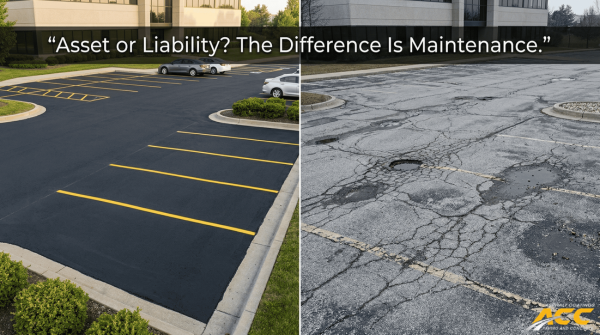
Asphalt pavement is a depreciating asset whose total cost of ownership depends on when and how you intervene during its lifecycle. Proactive maintenance preserves structural integrity at a fraction of reconstruction costs, while deferred action accelerates deterioration and multiplies expenses.
This guide covers the factors that determine pavement lifespan, the true costs of maintenance over time, the decision point between repair and replacement, ROI calculation methods, and a practical asset management approach.
Climate, material quality, and traffic loading interact to set the baseline lifespan of any asphalt surface. Environmental conditions alone can account for more than a third of total pavement damage over 15 years, and axle load impact follows an exponential curve where small weight increases cause disproportionate wear.
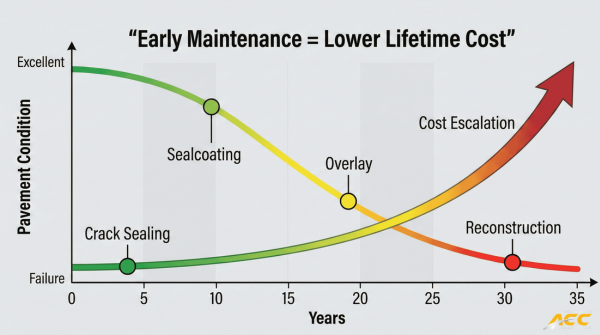
Maintenance costs span a wide range depending on treatment type. Crack sealing runs a few hundred dollars per lane mile annually, while mill-and-fill operations cost significantly more. Preventive treatments applied on a consistent schedule can be four to five times more cost-effective than waiting for full reconstruction.
Replacement becomes the better financial decision once pavement deterioration crosses a structural threshold where repairs no longer restore meaningful service life. Full reconstruction can cost $6 to $10 per square foot compared to pennies per square foot for sealcoating, making the timing of that crossover point critical.
Lifecycle cost analysis (LCCA) provides the framework for comparing maintenance and replacement strategies over periods of 35 years or more. Every dollar invested in timely preservation can save six to ten dollars in future reconstruction, making this analytical step essential for sound budget planning.
Applying these principles through scheduled services like crack repair, sealcoating, and overlay creates a structured asset management plan that extends pavement life and reduces total cost of ownership.
What Factors Influence the Lifespan of Asphalt Pavement?
The factors that influence the lifespan of asphalt pavement include climate conditions, installation quality, material selection, and usage intensity. The sections below examine how each factor accelerates or slows deterioration.
How Do Climate and Environmental Conditions Affect Asphalt Longevity?
Climate and environmental conditions affect asphalt longevity by accelerating physical and chemical deterioration through moisture, temperature extremes, and freeze-thaw cycling. Even without heavy traffic, these forces degrade pavement structure over time.
A 2019 FHWA study found that environmental factors account for an average of 36% of total damage to flexible pavements over a 15-year period. The primary mechanisms include:
- Moisture intrusion weakens the base and subgrade, causing premature structural failure.
- Extreme temperature swings trigger expansion and contraction, producing thermal cracking.
- Freeze-thaw cycles force water into small voids, then expand upon freezing, widening cracks from within.
Colorado’s Front Range presents unique pavement challenges due to extreme temperature swings and intense freeze-thaw cycling. Contractors with deep regional experience understand how to specify materials and maintenance schedules that account for these specific environmental stressors.

What Role Do Installation Quality and Materials Play in Durability?
Installation quality and materials play a defining role in durability because they establish the structural foundation that determines how well pavement resists traffic and environmental stress. Poor compaction, incorrect mix design, or substandard aggregate can shorten service life by years, regardless of maintenance efforts.
The Superpave Performance Grading system is the industry standard for specifying asphalt binders matched to local climate conditions. This system addresses rutting, fatigue cracking, and thermal cracking, ensuring the binder performs under site-specific temperature ranges. Proper subgrade preparation, correct lift thickness, and adequate drainage design are equally critical. Cutting corners during installation is one of the costliest mistakes in pavement management because the resulting defects compound over time.
How Does Usage Intensity Influence Wear and Tear?
Usage intensity influences wear and tear primarily through the weight and frequency of vehicle loads. The Equivalent Single Axle Load (ESAL) is the standard engineering unit for quantifying traffic impact on pavements. Damage follows an exponential relationship: a small increase in axle weight causes a disproportionately large increase in pavement deterioration, often approximated by a generalized fourth power law.
This means one fully loaded truck can inflict more structural damage than thousands of passenger car passes. Commercial properties with frequent delivery traffic, heavy equipment, or constant vehicle circulation experience significantly faster surface degradation. Commercial properties with complex traffic patterns—from delivery trucks at distribution centers to constant circulation at shopping centers—require contractors who understand how to design and maintain pavement systems for heavy-use scenarios specific to each property type.
Understanding these three factors together sets the stage for evaluating what maintenance truly costs over time.
What Are the True Costs of Asphalt Maintenance Over Time?
The true costs of asphalt maintenance over time depend on treatment type, frequency, and how proactively each task is scheduled. The following sections break down common maintenance tasks and their costs, optimal treatment intervals, and the financial benefits of routine upkeep.
What Are the Most Common Asphalt Maintenance Tasks and Their Typical Costs?
The most common asphalt maintenance tasks include crack sealing, chip seals, microsurfacing, thin overlays, and mill-and-fill operations. According to North Carolina Department of Transportation (NCDOT) data, costs per lane mile vary dramatically based on treatment scope and expected service life.
| Treatment Type | Expected Life (Years) | Total Cost/Lane Mile | Cost/Year/Lane Mile |
| Crack Seal | 4 | $1,400 | $350 |
| Chip Seal | 8 | $8,000 | $1,000 |
| Microsurfacing | 8 | $14,665 | $1,833 |
| Thin Overlay | 10 | $35,000 | $3,500 |
| Mill & Fill | 10 | $96,000 | $9,600 |
The annualized cost difference between crack sealing at $350 per year and mill-and-fill at $9,600 per year illustrates why early, low-cost interventions matter. Waiting until structural repairs are necessary can multiply annual expenses by more than 27 times.

How Often Should Preventative Maintenance Be Performed to Optimize Value?
Preventative maintenance should be performed on a cyclical schedule, typically every 5 to 10 years, depending on pavement condition and traffic levels. The FHWA recommends using Lifecycle Cost Analysis (LCCA) with an analysis period of at least 35 years to evaluate the long-term efficiency of different maintenance intervals. LCCA accounts for initial construction costs, future rehabilitation expenses, user costs from work zone delays, and residual pavement value at the end of the analysis period.
Treatments applied while pavement is still in good condition consistently outperform reactive strategies. For most commercial properties, scheduling sealcoating and crack sealing within the first few years of installation, then repeating on a consistent cycle, produces the lowest total cost of ownership.
What Are the Cost-Saving Benefits of Routine Maintenance?
The cost-saving benefits of routine maintenance are substantial and well documented. Preventive treatments applied on a regular schedule are four to five times more cost-effective than allowing pavement to deteriorate to the point of reconstruction, according to a 1996 FHWA report on pavement maintenance effectiveness.
Key financial benefits of routine maintenance include:
- Lower annualized costs per square foot compared to reactive repairs.
- Extended pavement service life, which defers expensive reconstruction by years or even decades.
- Reduced exposure to material price volatility, since smaller treatments require less asphalt and labor.
- Preserved property value, because well-maintained surfaces reflect positively on the overall asset.
Neglecting minor defects allows water infiltration, base failure, and structural damage to compound. Each of these problems escalates repair costs exponentially. Understanding these maintenance economics sets the stage for knowing when repair no longer makes sense and replacement becomes the better investment.
When Does It Make Sense to Replace Asphalt Instead of Maintaining It?
Replacing asphalt makes sense when cumulative repair costs exceed the price of reconstruction, or when structural failure makes maintenance ineffective. The signs that signal this threshold and the cost comparisons between ongoing repairs and full replacement are explored below.
What Signs Indicate That Replacement is More Cost-Effective Than Repair?
The signs that indicate replacement is more cost-effective than repair include widespread structural distress, recurring failures in previously patched areas, and base layer degradation that surface treatments cannot address. When alligator cracking covers large sections, subgrade failure causes persistent settling, or drainage issues compromise the pavement foundation, surface-level maintenance no longer delivers meaningful returns.
Timing is the critical variable. NCHRP Report 523, “Optimal Timing of Pavement Preventive Maintenance Treatment Applications,” provides a methodology for determining the best point to apply treatments based on pavement condition, climate, and traffic levels, emphasizing that treatments applied earlier in a pavement’s life are far more effective and economical. Once a surface deteriorates past the window where preventive maintenance can restore performance, each repair dollar yields diminishing results. At that stage, replacement becomes the more rational investment. For property managers tracking repair frequency, a pavement requiring annual patching in the same locations has likely crossed that economic threshold.

How Do Replacement Costs Compare to Ongoing Maintenance Costs?
Replacement costs are significantly higher per square foot than individual maintenance treatments, but the comparison shifts when repair frequency and cumulative spending are factored in. Current market rates illustrate the gap clearly:
- Sealcoating costs $0.15 to $0.90 per square foot.
- Crack filling runs approximately $1.50 per linear foot.
- Asphalt overlays range from $2.00 to $4.00 per square foot.
- Full replacement or reconstruction costs $6.00 to $10.00 per square foot.
A well-maintained surface receiving periodic sealcoating and crack filling accumulates far less total cost over a 20-year lifecycle than a neglected pavement requiring full reconstruction. However, when a pavement reaches advanced deterioration, stacking overlays onto a compromised base becomes a losing strategy. According to a seminal GAO report, every dollar spent on pavement preservation can save up to six dollars in future rehabilitation costs, which means the real comparison is not repair versus replacement at a single point in time, but total lifecycle expenditure across the pavement’s entire service life.
Understanding where your pavement sits on this cost curve helps determine whether continued investment in maintenance or a one-time replacement delivers better long-term value.
How Can Businesses Calculate the Long-Term Return on Investment of Asphalt Maintenance Versus Replacement?
Businesses can calculate the long-term return on investment of asphalt maintenance versus replacement by using lifecycle cost analysis tools and comparing per-square-foot costs across treatment options. The following sections cover predictive cost methods and how preventative maintenance shapes asset value.
What Tools or Methods Help Predict Future Maintenance and Replacement Costs?
The tools and methods that help predict future maintenance and replacement costs include lifecycle cost analysis (LCCA) and specialized software designed to model pavement deterioration over time. NCHRP Report 523 provides a detailed methodology and a software tool called OPTime that helps determine the optimal timing for preventive maintenance treatments, deferring the need for complete replacement. The FHWA’s LCCA guidelines emphasize factoring the timing of future rehabilitation activities into any cost projection. These approaches replace simple age-based triggers with data-driven decisions that account for pavement condition, traffic loads, and climate. For commercial property managers, adopting LCCA early prevents the common mistake of budgeting reactively, which almost always costs more.
How Does Preventative Maintenance Influence Asset Value and Budget Planning?
Preventative maintenance influences asset value and budget planning by extending pavement service life while keeping annual expenditures predictable and low. When preservation treatments are applied proactively, businesses avoid the financial shock of full reconstruction, which costs $6.00 to $10.00 per square foot. By contrast, a slurry seal can cost as little as $6.20 per square yard compared to $89 per square yard for reconstruction. This cost gap makes scheduled maintenance a far more effective capital allocation strategy. Well-maintained asphalt also supports higher property valuations, since visible surface deterioration signals deferred liability to appraisers and prospective tenants. Budgeting for routine treatments creates a stable, forecastable expense line rather than an unpredictable capital emergency.
With ROI strategies established, the next step is applying these principles through a trusted maintenance partner.
How Should You Approach Asphalt Asset Management Using Services from Asphalt Coatings Company?
You should approach asphalt asset management by partnering with a contractor that delivers proactive preservation services tailored to your pavement’s specific conditions. The following subsections explain how Asphalt Coatings Company maximizes asset value and summarize the key takeaways from this guide.
Can Asphalt Repair and Sealcoating Services from Asphalt Coatings Company Help Maximize Asphalt Asset Value?
Yes, asphalt repair and sealcoating services from Asphalt Coatings Company can help maximize asphalt asset value by applying the same proactive preservation principles that state transportation agencies use to extend pavement life and reduce long-term costs. Authoritative research confirms that every dollar invested in timely maintenance saves between six and ten dollars in future reconstruction costs.
Asphalt Coatings Company delivers targeted services that align with this strategy:
- Crack sealing with CDOT-approved materials prevents moisture intrusion that accelerates structural damage.
- Sealcoating protects against UV degradation and oxidation, which can be especially aggressive in Colorado’s high-altitude climate.
- Asphalt overlays, typically ranging from $2.00 to $4.00 per square foot, restore surface integrity at a fraction of full replacement cost.
- Mill and pave services address deeper deterioration before it reaches the subgrade.

Asphalt Coatings Company has served Colorado’s Front Range since 1986, building 39 years of expertise in managing pavement through the region’s demanding freeze-thaw cycles. This Colorado-specific experience ensures that material selection and treatment timing match actual site conditions, not generic guidelines. With understanding of how maintenance choices translate to budget outcomes, partnering with a knowledgeable contractor remains the most practical path to long-term pavement value.
What Are the Key Takeaways About Asphalt as an Asset: Maintenance vs Replacement Cost Over Time We Covered?
The key takeaways about asphalt as an asset: maintenance vs replacement cost over time are that proactive preservation dramatically outperforms reactive reconstruction in both cost efficiency and pavement longevity. According to a seminal GAO report, every dollar spent on pavement preservation can save up to six dollars in future rehabilitation costs.
The most actionable lessons from this guide include:
- Climate, material quality, and traffic load are the three primary factors controlling asphalt lifespan.
- Routine treatments like crack sealing and sealcoating cost a fraction of full replacement while resetting the deterioration curve.
- Lifecycle cost analysis should drive replacement timing, not pavement age alone.
- Minimizing present-value costs, rather than minimizing initial costs, produces the best financial outcome over a pavement’s full service life.
For commercial property managers and facility owners, treating asphalt as a depreciating asset that responds to strategic reinvestment is the single most effective way to protect budgets and property value over time.