The 20-year lifecycle of a commercial asphalt parking lot is the predictable progression of pavement condition from initial installation through eventual reconstruction, shaped by material quality, environmental exposure, and maintenance decisions at every stage.
This guide covers the distinct phases of pavement aging, the maintenance strategies that extend useful life, the environmental factors that accelerate deterioration, the warning signs of structural failure, and how professional pavement services protect your long-term investment.
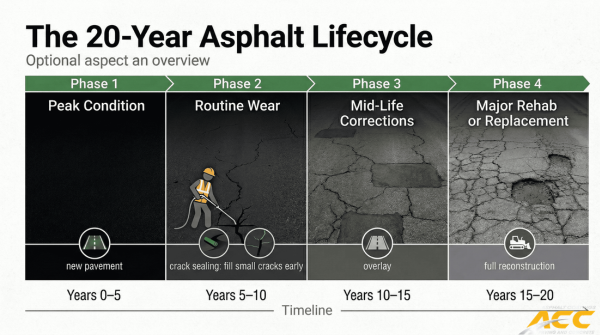
A commercial asphalt parking lot moves through four general stages over its 20-year design life. The first five years represent peak condition, where preventative treatments like sealcoating and crack sealing preserve flexibility and block moisture intrusion. Years five through ten bring routine wear that requires patching and continued surface protection. By mid-life, corrective maintenance such as overlay evaluation and extensive crack filling becomes necessary as oxidation and traffic loading compound.
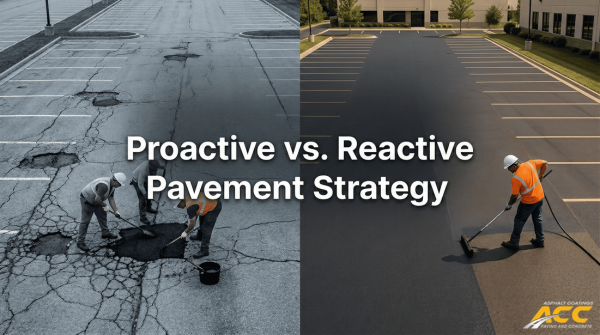
Proactive maintenance delivers outsized returns. Early interventions keep repair costs low, while delayed action allows minor surface issues to escalate into base failures that cost significantly more to fix. Sealcoating every two to three years, prompt crack sealing, and regular striping form the foundation of any effective pavement management plan.
Climate conditions play a direct role in how quickly asphalt deteriorates. High-altitude UV exposure accelerates binder oxidation, making the surface brittle and prone to cracking. Freeze-thaw cycles compound this damage as trapped water expands within cracks, widening them into potholes and structural failures over successive seasons.
Recognizing end-of-life indicators (widespread alligator cracking, base failure, drainage problems) helps property owners decide between overlay and full reconstruction before safety and liability risks escalate. We work with property owners to assess pavement conditions at every stage and apply the right treatment at the right time.
What Are the Main Phases in the Lifespan of a Commercial Asphalt Parking Lot?
The main phases in the lifespan of a commercial asphalt parking lot are initial installation, early preventative maintenance, mid-life corrective repairs, and environmental weathering management. Each phase demands specific actions to protect the pavement investment.
What Happens During the Initial Installation Phase?
The initial installation phase is when the structural foundation of the parking lot is established. This phase determines the pavement’s long-term performance. Key steps include:
- Subgrade preparation and compaction to create a stable foundation.
- Aggregate base placement at the specified density.
- Asphalt surface and binder course placement at proper temperatures.
- Drainage grading with a minimum 1-2% slope to prevent water ponding.
- ADA-compliant design integration to avoid costly future rework.

Asphalt Coatings Company’s in-house crews handle every phase of installation—from subgrade preparation through final paving—ensuring quality control throughout the entire construction process without relying on subcontractors.
How Is Early Maintenance Crucial in the First Few Years?
Early maintenance is crucial in the first few years because it preserves the pavement while it is still in excellent condition, at the lowest possible cost. During years one through five, recommended actions include preventative sealcoating every two to three years and prompt crack sealing. According to a PaveConnect maintenance guide, these early interventions cost approximately $0.20 to $0.50 per square foot. That modest investment prevents water infiltration and UV damage before they compound into structural problems. Property managers who delay maintenance past this window often face repair costs that multiply several times over.
What Mid-Life Issues Typically Develop in Asphalt Parking Lots?
Mid-life issues that typically develop in asphalt parking lots include oxidation cracking, minor surface raveling, pothole formation, and fading striping. These problems generally emerge between years five and fifteen as the asphalt binder loses flexibility. According to a 2025 Angi pricing guide, initial construction costs range from $2.50 to $4.50 per square foot, yet mid-life corrective repairs can approach or exceed those original costs if neglected. Routine patching, continued sealcoating, and overlay evaluations become essential during this stage. Addressing issues promptly at mid-life is where proactive property managers separate themselves from those facing premature full reconstruction.

How Do Environmental Factors Like Freeze-Thaw Cycles Impact Longevity?
Environmental factors like freeze-thaw cycles impact longevity by progressively breaking apart the pavement structure from within. Water seeps into small surface cracks, and when it freezes, it expands by approximately 9%, exerting significant internal pressure. Some areas experience over 120 freeze-thaw cycles annually, making this a primary driver of pavement distress. Each cycle widens existing cracks and creates new ones, eventually forming potholes and base failures. This relentless mechanical stress means that even well-constructed pavements require aggressive, climate-specific maintenance strategies to reach their full 20-year design life.

With these lifecycle phases established, the next step is understanding which maintenance strategies deliver the greatest return at each stage.
What Maintenance Strategies Extend the Life of an Asphalt Parking Lot?
The maintenance strategies that extend the life of an asphalt parking lot include sealcoating, crack sealing, regular striping, and preventative cost planning. Below, each strategy is covered with recommended timing and long-term cost impact.
How Often Should Sealcoating and Crack Filling Be Performed?
Sealcoating should be applied every 2 to 3 years, while crack filling should occur as soon as new cracks appear. Sealcoating protects asphalt from UV radiation, water infiltration, and chemical damage at a cost of $0.20 to $0.50 per square foot. Crack sealing typically costs $1 to $3 per linear foot. According to the National Center for Asphalt Technology (NCAT), crack sealing alone can extend pavement life by 2 to 5 years. As a parking lot ages past year five, maintenance needs intensify: routine pothole patching joins continued sealcoating, and by years 7 through 15, extensive crack filling and overlay evaluation become necessary. Staying ahead of these intervals is the single most effective way to avoid premature failure.
Why Is Regular Striping Important for Both Safety and Durability?
Regular striping is important for both safety and durability because it maintains clear traffic flow, defines pedestrian zones, and supports ADA compliance. Faded or missing lines increase accident risk and create liability exposure for property owners. Beyond visibility, striping also serves a diagnostic function; when lines wear unevenly, it reveals high-traffic zones experiencing accelerated surface wear. Restripping every 1 to 2 years, or after sealcoating, keeps markings visible and helps property managers monitor pavement condition across the lot.
What Preventative Measures Reduce Long-Term Repair Costs?
The preventative measures that reduce long-term repair costs include early-stage sealcoating, prompt crack sealing, proper drainage maintenance, and Life-Cycle Cost Analysis planning. For every $1 spent on preventative maintenance, an estimated $5 to $10 is saved in future rehabilitation costs. The Federal Highway Administration (FHWA) recommends Life-Cycle Cost Analysis (LCCA) to evaluate total pavement costs, including construction, maintenance, rehabilitation, and user costs over the full service life. A proactive maintenance approach can extend asphalt parking lot life by 50% or more, making it one of the highest-return investments a commercial property owner can make. Knowing which signs signal the shift from maintenance to major repair helps owners plan their next steps effectively.
How Do Colorado’s Climate and Environmental Conditions Affect Asphalt Parking Lots?
Colorado’s climate and environmental conditions affect asphalt parking lots by accelerating deterioration through intense UV radiation, extreme temperature swings, and repeated freeze-thaw cycles. The following sections cover high-altitude challenges, freeze-thaw-resistant design, and the value of regional expertise.
What Unique Challenges Do High Altitude and Temperature Swings Present?
The unique challenges that high altitude and temperature swings present include accelerated UV oxidation, rapid binder aging, and reduced fracture toughness from extreme thermal cycling. Colorado’s combination of high altitude, intense UV radiation, and frequent freeze-thaw cycles accelerates asphalt deterioration far beyond what lower-elevation regions experience.
Denver, at 5,280 feet elevation, receives approximately 15–20% more UV radiation than sea-level locations. This intense exposure triggers photo-oxidation, a process that causes asphalt binder to become brittle and crack-prone. A thinner atmosphere at altitude offers less natural UV filtration, so pavement surfaces age faster with each season of sun exposure.
A 2024 study published in Nature on asphalt concrete performance found that freeze-thaw cycles significantly reduce fracture toughness, with the impact even more pronounced in high-altitude regions where temperature swings are more extreme. Once brittleness from UV damage combines with freeze-thaw stress, the pavement deteriorates on two fronts simultaneously.
How Can a Parking Lot Be Designed to Withstand Freeze-Thaw Damage?
A parking lot can be designed to withstand freeze-thaw damage through proper material selection, drainage engineering, and structural thickness. Key design strategies include:
- Climate-graded binders: Specifying Performance-Graded asphalt binders, such as PG 58-28, ensures the mix remains flexible at -28°C while resisting softening at 58°C.
- Adequate drainage slope: Maintaining a minimum 1–2% surface grade prevents water from ponding and infiltrating the pavement structure.
- Proper base depth: A well-compacted aggregate base of appropriate thickness provides structural support and limits moisture migration to the subgrade.
- Timely crack sealing: Addressing cracks before winter prevents water intrusion that drives freeze-thaw expansion damage.
Selecting the right binder grade for Colorado’s temperature range is arguably the single most impactful design decision property owners can make.
Why Is Regional Expertise Critical for Long-Term Performance?
Regional expertise is critical for long-term performance because Colorado’s environmental demands require specialized knowledge that generic paving approaches cannot address. Standard material specifications and maintenance schedules developed for moderate climates often fall short when applied to high-altitude conditions with extreme UV exposure and over 120 annual freeze-thaw cycles.
With 39 years serving Colorado’s Front Range, Asphalt Coatings Company has developed specialized material specifications and maintenance protocols designed specifically for the region’s high-altitude UV exposure and extreme freeze-thaw conditions. Without it, even well-built parking lots can underperform their projected 20-year service life.
Understanding how Colorado’s climate shapes pavement performance makes it easier to recognize when a parking lot is approaching the end of its useful life.
What Signs Indicate a Parking Lot Is Nearing the End of Its Useful Life?
The signs that indicate a parking lot is nearing the end of its useful life include widespread cracking, base failure, drainage problems, and surface deterioration that no longer responds to routine repairs. Below, we cover common failures, when major intervention is needed, and how to evaluate repair investments.
What Are Common Surface and Structural Failures After 15-20 Years?
Common surface and structural failures after 15-20 years include alligator cracking, rutting, potholes, base course deterioration, and subgrade failure. Alligator cracking signals fatigue in the asphalt structure, not just the surface. Rutting indicates permanent deformation in one or more pavement layers, often from repeated heavy loads. Potholes form when water infiltrates cracks, freezes, and breaks apart surrounding material. According to PaveConnect’s maintenance guide, parking lots in “poor” condition during this stage require major rehabilitation or reconstruction, with costs reaching $3.00 to $5.00 or more per square foot. When multiple distress types appear simultaneously, the pavement has likely exhausted its structural capacity. Isolated patching at this stage often accelerates failure in adjacent areas rather than extending overall pavement life.
When Is Milling, Overlay, or Full Replacement Necessary?
Milling, overlay, or full replacement is necessary when the pavement condition has declined beyond what surface treatments can correct. Each option suits a different level of deterioration:
- Milling and overlay is appropriate when surface distress is widespread but the aggregate base remains structurally sound.
- Full-depth replacement is necessary when the base course or subgrade has failed, evidenced by large areas of alligator cracking, significant rutting, or standing water from compromised drainage.
- Partial reconstruction targets isolated sections where base failure is localized while surrounding pavement remains viable.
If more than 30 to 40 percent of the surface shows structural distress, overlay alone typically cannot deliver a full additional service cycle. In most cases, full replacement proves more cost-effective than repeated repairs on a compromised foundation.
How Can Owners Evaluate When to Invest in Major Repairs?
Owners can evaluate when to invest in major repairs by comparing the cost of continued maintenance against the cost of rehabilitation or reconstruction. A pavement that requires frequent patching, with repair costs climbing each year, has often crossed the threshold where continued maintenance wastes money.
Key evaluation factors include:
- The percentage of surface area exhibiting structural distress.
- Whether drainage systems still function as designed.
- The condition of the aggregate base, confirmed through core samples.
- Total annual repair spending relative to reconstruction cost.
Life-Cycle Cost Analysis, as outlined by the Federal Highway Administration, provides a structured method for comparing these long-term costs. Property owners who track repair frequency and spending over time can identify the inflection point where replacement delivers better value than continued patching.
With clear indicators of end-of-life failure identified, partnering with experienced professionals ensures the right rehabilitation strategy is chosen.
How Should You Approach Extending the Lifecycle of Your Parking Lot with Asphalt Coatings Company’s Services?
You should approach extending the lifecycle of your parking lot by partnering with Asphalt Coatings Company for professional paving, sealcoating, striping, and ongoing maintenance. Below, we cover how comprehensive services help and the key takeaways from this lifecycle analysis.
Can Comprehensive Paving, Sealcoating, and Striping Services from Asphalt Coatings Company Help Your Lot Last Longer?
Yes, comprehensive paving, sealcoating, and striping services from Asphalt Coatings Company can help your lot last longer. Preventative maintenance is not a cost; it is an investment. Early, regular interventions such as sealcoating and crack sealing yield a substantial return by delaying costly rehabilitation and reconstruction.Asphalt Coatings Company provides these services with in-house crews and 39 years of Colorado-specific expertise. According to a 2020 study by the National Center for Asphalt Technology, crack sealing alone can extend pavement life by 2 to 5 years. When paving, sealcoating, crack sealing, and striping work together under one provider, each treatment reinforces the others. This integrated approach is one of the most effective ways to protect a parking lot investment over a full 20-year service life.
What Are the Key Takeaways About the 20-Year Lifecycle of a Commercial Asphalt Parking Lot We Covered?
The key takeaways about the 20-year lifecycle of a commercial asphalt parking lot are:
- A typical commercial parking lot is designed for a 20-year service life, with required thickness varying by subgrade strength and traffic volume.
- The lifecycle divides into four stages, each demanding progressively more intensive maintenance, from sealcoating in years one through five to major rehabilitation after year twelve.
- Colorado’s high altitude, intense UV radiation, and frequent freeze-thaw cycles accelerate deterioration, making proactive maintenance even more critical.
- Preventative strategies such as sealcoating, crack sealing, proper drainage, and professional assessments dramatically reduce long-term costs.
Facility managers who work with qualified pavement professionals to conduct regular assessments and develop a long-term maintenance plan consistently achieve better outcomes. Asphalt Coatings Company specializes in exactly this kind of partnership, combining paving, sealcoating, crack sealing, striping, and concrete work under one roof to keep commercial parking lots performing at their best across every lifecycle stage.